Figures in Australian Rock Art Are Only Ever Depicted in Outline

Indigenous Australian art includes art fabricated by Aboriginal Australian and Torres Strait Islander peoples, including collaborations with others. Information technology includes works in a wide range of media including painting on leaves, bawl painting, woods etching, rock carving, watercolour painting, sculpting, ceremonial clothing and sand painting; fine art by Ethnic Australians that pre-dates European colonisation by thousands of years, up to the present day.
Traditional Indigenous art [edit]
There are several types of and methods used in making Ancient art, including rock painting, dot painting, rock engravings, bark painting, carvings, sculptures, and weaving and string art. Australian Aboriginal art is the oldest unbroken tradition of art in the world.[ane] [ii]
Stone fine art [edit]

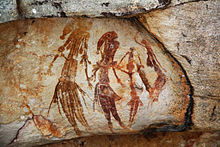
This photo shows the painting of Baiame made by an unknown Wiradjuri artist in "Baiame's cavern", near Singleton, NSW. Find the length of his arms which extend to the 2 trees either side.
Rock art, including painting and engraving or carving (petroglyphs), can exist plant at sites throughout Australia. Examples of rock art have been plant that are believed to depict extinct megafauna such as Genyornis [three] and Thylacoleo in the Pleistocene era[4] besides as more recent historical events such as the arrival of European ships.[5]
The oldest examples of rock art, in Western Australia's Pilbara region and the Olary district of Southward Commonwealth of australia, are estimated to exist upward to around forty,000 years old.[6] The oldest firmly dated evidence of rock art painting in Australia is a charcoal cartoon on a small rock fragment institute during the earthworks of the Narwala Gabarnmang stone shelter in south-western Arnhem Land in the Northern Territory. Dated at 28,000 years, it is one of the oldest known pieces of rock art on Earth with a confirmed date.[vii] It is thought this decorated fragment may take once formed part of a larger ceiling artwork, however, the shape of the original motif is unknown.[eight] The oldest reliably dated unambiguous, in-situ rock art motif in Commonwealth of australia is a large painting of a macropod from a stone shelter in Western Australia'south Kimberley region, radiometrically dated in a February 2021 study at approximately 17,300 years erstwhile.[9]
Gwion Gwion rock fine art (the "Bradshaw stone paintings", likewise referred to as Giro Giro"[2]), initially named after Joseph Bradshaw, who starting time reported them in 1891, consists of a serial of rock paintings on caves in the Kimberley region of Western Commonwealth of australia.[seven] A 2020 study puts this fine art at about 12,000 years onetime.[10] [eleven]
The Maliwawa Figures were documented in a study led by Paul Taçon and published in Australian Archæology in September 2020.[12] The art includes 572 images across 87 sites in northwest Arnhem State, from Awunbarna (Mount Borradaile[xiii]) area across to the Wellington Range. They are estimated to have been drawn between 6,000 and 9,400 years ago.[14] The find is described every bit very rare, not only in manner, but in their depiction of bilbies (not known historically in Arnhem Land)[15] and the commencement known depiction of a dugong.[16] The art, all paintings in red to mulberry colour apart from one cartoon, and in a naturalistic style, had not been described in the literature earlier this report. They are large, and depict relationships between people and animals, a rare theme in stone art. Bilbies, thylacines and dugong have been extinct in Arnhem land for millennia. The art was first seen by the 2008-2009 researchers, but were only studied in field research lasting from 2016 to 2018. The figures were named by Ronald Lamilami, a senior traditional owner.[13] [17] According to Tacon, "The Maliwawa back-to-dorsum figures are the oldest known for western Arnhem Land and it appears this painting convention began with the Maliwawa style. It continues to the present with bark paintings and paintings on paper".[18] Taçon draws comparisons between the Maliwawa Figures and George Chaloupka's Dynamic Figures style, where the subject thing consists of near 89 percent humans, compared with 42% of the Maliwawa Figures.[nineteen] In that location is, yet, much complexity and debate regarding the classification of rock art way in Arnhem Land.[12] [xx]
Other painted rock fine art sites include Laura, Queensland,[21] Ubirr, in the Kakadu National Park,[22] Uluru,[23] and Carnarvon Gorge.[24]
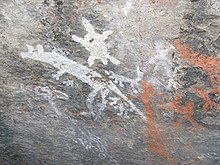
Rock engraving, or petroglyphs, are created by methods which vary depending on the blazon of rock existence used and other factors. There are several different types of rock art across Australia, the well-nigh famous of which is Murujuga in Western Australia, the Sydney rock engravings effectually Sydney in New S Wales, and the Panaramitee rock art in Key Australia. The Toowoomba engravings, depicting carved animals and humans, have their own peculiar style not establish elsewhere in Australia.[ citation needed ]
The rock engravings at Murujuga are said to exist the earth's largest collection of petroglyphs[25] and includes images of extinct animals such as the thylacine. Activity prior to the concluding ice historic period until colonisation is recorded.
Stone arrangements [edit]
Ancient stone arrangements are a course of rock fine art constructed by Aboriginal Australians. Typically they consist of stones, each of which may be nigh 30 cm in size, laid out in a blueprint extending over several metres or tens of metres. Each stone is well-embedded into the soil, and many have "trigger-stones" to support them. Especially fine examples are in the state of Victoria, where some examples take very large stones. For example, the stone system at Wurdi Youang consists of almost 100 stones bundled in an egg-shaped oval nigh 50 metres (160 ft) across.[ citation needed ] The appearance of the site is similar to that of the megalithic rock circles plant throughout Uk (although the function and civilisation are presumably completely different). Although its clan with Aboriginal Australians is well-authenticated and across doubtfulness, the purpose is unclear, although it may have a connection with initiation rites. It has likewise been suggested that the site may have been used for astronomical purposes.[26] Smaller rock arrangements are found throughout Australia, such every bit those most Yirrkala, which draw authentic images of the praus used by Macassan Trepang fishermen and spear throwers.[ commendation needed ]
Wood carvings [edit]
Wood etching has always been an essential part of Aboriginal culture, requiring wood, sharp stone to carve, wire and fire. The wire and fire were used to create patterns on the object by heating the wire with the fire and placing it on the woods carving.
Wood carvings such every bit those past Central Australian artist Erlikilyika shaped similar animals, were sometimes traded to Europeans for goods. The reason Aboriginal people made forest carvings was to help tell their Dreaming stories and pass on their grouping's lore and essential data about their land and community. They were besides used in ceremonies, such as the ilma.
Ancient people from the Tiwi Islands traditionally carved pukumani grave posts,[27] and since the 1960s accept been carving and painting atomic number 26 wood figures.[28]
Textiles [edit]
In most Pacific areas the men oversee the art and compages; the women oversee the art in felted textile they would make from tree bark and plants. The art in clothing is supervised past the head woman in charge of the production. These detailed clothes were worn for rituals; each represented wealth and rank in the group. The sacred clothing is also used in merchandise goods and social and political relationships. Wearing the material so removing it and giving information technology to another person helped to bond or reinforce friendship or alliances.[29]
Baskets and weaving [edit]
Baskets, sometimes coiled baskets, were created by twisting bawl, palm-leaf, and feathers; some of the baskets were plain and some were created with feather pendants or feathers woven in the frame of the handbasket. The artists used mineral and institute dyes to colour the palm-leaves and bark of the hibiscus. These cord bags and baskets were used in ceremonies for religious and ritual needs; the baskets might take been also used for carry things back to the hamlet.[thirty]
Basket weaving has been traditionally practised past the women of many Ancient Australian peoples across the continent for centuries.[31] [32] [33] [34]
Jewellery [edit]
Aboriginal people created beat out pendants which were considered high value and often used for trading goods. These shells were attached to string, which was handmade from human pilus and sometimes covered with a type of grease and red ochre. This jewellery would sometimes exist hung around a human being's cervix or waist for apply during ceremonies.[35]
Kalti paarti [edit]
Kalti paarti carving is a traditional art course made past carving emu eggs. It is non as old equally some other techniques, having originated in the nineteenth century.[36]
Symbols [edit]
Certain symbols within the Ancient modern fine art movement retain the aforementioned significant beyond regions although the pregnant of the symbols may modify within the context of a painting. When viewed in monochrome other symbols can await similar, such as the circles within circles, sometimes depicted on their own, sparsely, or in clustered groups. Depending upon the group of which the artist is a fellow member, symbols such equally campfire, tree, colina, digging hole, waterhole, or spring can vary in pregnant. Use of the symbol can be clarified further by the use of colour, such as h2o existence depicted in blue or blackness.
Many paintings by Aboriginal artists, such as those that stand for a Dreaming story, are shown from an aeriform perspective. The narrative follows the lie of the land, as created by bequeathed beings in their journeying or during creation. The modern day rendition is a reinterpretation of songs, ceremonies, stone art, body art and ceremonies (such as awelye) that was the norm for many thousands of years.
Any the meaning, interpretations of the symbols should be fabricated in context of the entire painting, the region from which the artist originates, the story behind the painting, and the fashion of the painting.[ citation needed ]
Religious and cultural aspects of Aboriginal art [edit]
Some natural sites were sacred to them, and were also the location where seasonal rituals were performed. During these rituals the Aboriginal people created art such every bit plume and fibre objects, they painted and created stone engravings, and also painted on bark of the Eucalyptus tetrodonta trees. While stories differed among the clans, language groups, and wider groups, the Dreaming (or Jukurrpa) is common to all Aboriginal peoples. As part of these beliefs, during aboriginal times mythic Aboriginal ancestor spirits were the creators of the state and sky, and eventually became a function of it. The Aboriginal peoples' spiritual beliefs underpin their laws, fine art forms, and ceremonies. Traditional Ancient art almost always has a mythological undertone relating to the Dreaming.[ citation needed ]
Wenten Rubuntja, an Indigenous landscape artist, says it is hard to find any art that is devoid of spiritual significant:
Doesn't matter what sort of painting we practise in this country, information technology still belongs to the people, all the people. This is worship, work, culture. It's all Dreaming. There are ii means of painting. Both ways are important, because that'due south civilisation. – source The Weekend Australian Magazine, April 2002
Story-telling and totem representation feature prominently in all forms of Aboriginal artwork. Additionally, the female form, particularly the female womb in 10-ray style, features prominently in some famous sites in Arnhem Land. X-ray styles date back all the style to 2000–1000 BCE. Information technology is an Indigenous technique where the artist creates conceptualised X-ray, transparent , images. The mimi, spirits who taught the art of painting to the Aboriginal people, and ancestors are "released" through these types of artwork.
Graffiti and other destructive influences [edit]
Many culturally meaning sites of Aboriginal stone paintings take been gradually desecrated and destroyed by inroad of early settlers and modernistic-24-hour interval visitors. This includes the devastation of art past immigration and construction work, erosion caused by excessive touching of sites, and graffiti. Many sites now belonging to National Parks have to be strictly monitored past rangers, or closed off to the public permanently.
Torres Strait Islander fine art [edit]
Mythology and civilisation, deeply influenced by the ocean and the natural life around the islands, have always informed traditional artforms. Featured strongly are turtles, fish, dugongs, sharks, seabirds and saltwater crocodiles, which are considered totemic beings.[37]
Elaborate headdresses or dhari (too spelt dari [38]), every bit featuried on the Torres Strait Islander Flag, are created for the purposes of ceremonial dances.[39] The dari was historically worn by Torres Strait warriors in boxing. Information technology is seen as a powerful symbol of the Torres Strait Islander people, today representing peace and harmony. Earth-renowned creative person Ken Thaiday Snr has created elaborate dharis using modernistic materials in his contemporary artwork.[40]
Torres Strait Islander people are the simply culture in the earth to make turtleshell masks, known as krar (turtleshell) in the Western Islands and le-op (human being face) in the Eastern Islands.[41]
Prominent amongst the artforms is wame (alt. wameya), many different string figures.[42] [43] [44]
The Islands accept a long tradition of woodcarving, creating masks and drums, and etching decorative features on these and other items for ceremonial apply. From the 1970s, young artists were get-go their studies at around the same fourth dimension that a significant re-connection to traditional myths and legends was happening. Margaret Lawrie's publications, Myths and Legends of the Torres Strait (1970) and Tales from the Torres Strait (1972), reviving stories which had all simply been forgotten, influenced the artists greatly.[45] [46] While some of these stories had been written down by Haddon after his 1898 expedition to the Torres Strait,[47] many had afterwards fallen out of use or been forgotten.
In the 1990s a group of younger artists, including the accolade-winning Dennis Nona (b.1973), started translating these skills into the more portable forms of printmaking, linocut and carving, besides as larger scale bronze sculptures. Other outstanding artists include Billy Missi (1970-2012), known for his decorated black and white linocuts of the local vegetation and eco-systems, and Alick Tipoti (b.1975). These and other Torres Strait artists have profoundly expanded the forms of Ethnic art within Australia, bringing superb Melanesian carving skills every bit well every bit new stories and subject thing.[41] The Higher of Technical and Further Education on Thursday Island was a starting indicate for young Islanders to pursue studies in fine art. Many went on to farther fine art studies, especially in printmaking, initially in Cairns, Queensland and later at the Australian National University in what is now the School of Art and Pattern. Other artists such as Laurie Nona, Brian Robinson, David Bosun, Glen Mackie, Joemen Nona, Daniel O'Shane and Tommy Pau are known for their printmaking work.[48]
An exhibition of Alick Tipoti'southward work, titled Zugubal, was mounted at the Cairns Regional Gallery in July 2015.[49] [50]
Gimmicky Indigenous art [edit]
Mod Aboriginal artists [edit]


In 1934 Australian painter Rex Batterbee taught Aboriginal artist Albert Namatjira western style watercolour landscape painting, along with other Ancient artists at the Hermannsburg mission in the Northern Territory. Information technology became a popular style, known as the Hermannsburg School, and sold out when the paintings were exhibited in Melbourne, Adelaide and other Australian cities. Namatjira became the outset Aboriginal Australian denizen, as a result of his fame and popularity with these watercolour paintings.
In 1966, ane of David Malangi'southward designs was produced on the Australian one dollar note, originally without his knowledge. The subsequent payment to him past the Reserve Bank marked the first case of Aboriginal copyright in Australian copyright law.
In 1988 the Aboriginal Memorial was unveiled at the National Gallery of Australia in Canberra made from 200 hollow log coffins, which are like to the type used for mortuary ceremonies in Arnhem Land. It was made for the bicentenary of Australia's colonisation, and is in remembrance of Aboriginal people who had died protecting their land during conflict with settlers. It was created by 43 artists from Ramingining and communities nearby. The path running through the eye of it represents the Glyde River.[51]
In that same year, the new Parliament Firm in Canberra opened with a forecourt featuring a design by Michael Nelson Tjakamarra, laid as a mosaic.
The belatedly Rover Thomas is another well known modern Australian Aboriginal artist. Built-in in Western Australia, he represented Commonwealth of australia in the Venice Biennale of 1990. He knew and encouraged other now well-known artists to pigment, including Queenie McKenzie from the E Kimberley / Warmun region, every bit well equally having a potent influence on the works of Paddy Bedford and Freddy Timms.
In the late 1980s and early 1990s the work of Emily Kngwarreye, from the Utopia community north east of Alice Springs, became very pop. Although she had been involved in craftwork for most of her life, information technology was only when she was in her 80s that she was recognised as a painter. Her works include Globe's Creation. Her styles, which inverse every twelvemonth, accept been seen as a mixture of traditional Aboriginal and contemporary Australian. Her ascent in popularity has prefigured that of many Ethnic artists from cardinal, northern and western Australia, such as Kngwarreye's niece Kathleen Petyarre, Angelina Pwerle, Minnie Pwerle, Dorothy Napangardi, Lena Pwerle, and dozens of others, all of whose works accept get highly sought-after. The popularity of these ofttimes elderly artists, and the resulting pressure placed upon them and their health, has become such an result that some fine art centres have stopped selling these artists' paintings online, instead placing prospective clients on a waiting listing for work.[52]
Current artists in vogue include Jacinta Hayes, pop for her iconic representation of "Bush Medicine Leaves" and "Honey Ants", Male monarch Sultan (who studied with Albert Namatjira), Trephina Sultan and Reggie Sultan, Bessie Pitjara and Joyce Nakamara, amongst others.[53]
Despite concerns about supply and demand for paintings, the remoteness of many of the artists, and the poverty and health problems experienced in the communities, at that place are widespread estimates of an industry worth close to half a billion Australian dollars each year, and growing rapidly.[54]
Papunya Tula and "dot painting" [edit]
In 1971–1972, art teacher Geoffrey Bardon encouraged Aboriginal people in Papunya, north west of Alice Springs to put their Dreamings onto canvas. These stories had previously been fatigued on the desert sand, and were now given a more than permanent grade.
The dots were used to encompass hugger-mugger-sacred ceremonies. Originally, the Tula artists succeeded in forming their ain visitor with an Ancient Proper name, Papunya Tula Artists Pty Ltd,[55] still a time of disillusionment followed as artists were criticised by their peers for having revealed too much of their sacred heritage. Secret designs restricted to a ritual context were now in the marketplace place, fabricated visible to Australian Aboriginal painting. Much of the Ancient art on brandish in tourist shops traces back to this style adult at Papunya. The most famous of the artists to come from this movement was Clifford Possum Tjapaltjarri. Also from this movement is Johnny Warangkula, whose Water Dreaming at Kalipinya twice sold at a record price, the second time being $486,500 in 2000.
The Papunya Collection at the National Museum of Australia contains over 200 artifacts and paintings, including examples of 1970s dot paintings.[56]
Issues [edit]

There accept been cases of some exploitative dealers (known as carpetbaggers) that accept sought to profit from the success of the Ancient art movements. Since Geoffrey Bardon'due south time and in the early years of the Papunya movement, in that location has been concerns about the exploitation of the largely illiterate and not-English speaking artists.
One of the main reasons the Yuendumu motility was established, and later flourished, was due to the feeling of exploitation amongst artists:
"Many of the artists who played crucial roles in the founding of the fine art center were aware of the increasing interest in Aboriginal art during the 1970s and had watched with concern and curiosity the developments of the art motility at Papunya amongst people to whom they were closely related. There was likewise a growing private market for Aboriginal art in Alice Springs. Artists' experiences of the private market place were marked past feelings of frustration and a sense of disempowerment when buyers refused to pay prices which reflected the value of the Jukurrpa or showed little involvement in agreement the story. The establishment of Warlukurlangu was one way of ensuring the artists had some control over the purchase and distribution of their paintings."[57]
Other cases of exploitation include:
- painting for a lemon (car): "Artists have come to me and pulled out photos of cars with mobile phone numbers on the back. They're asked to paint ten-xv canvasses in exchange for a motorcar. When the 'Toyotas' materialise, they often get in with a flat tyre, no spares, no jack, no fuel." (Coslovich 2003)
- preying on a sick artist: "Fifty-fifty coming to town for medical treatment, such equally dialysis, tin can make an artist easy casualty for dealers wanting to make a quick turn a profit who congregate in Alice Springs" (op.cit.)
- pursuing a famous creative person: "The late (great) Emily Kngwarreye...was relentlessly pursued by carpetbaggers towards the end of her career and produced a big but inconsistent torso of work." Co-ordinate to Sotheby's "Nosotros take about one in every 20 paintings of hers, and with those we expect for provenance we can be 100% certain of." (op.cit.)
In March 2006, the ABC reported art fraud had hitting the Western Australian Ancient Art movements. Allegations were made of sweatshop-like atmospheric condition, fake works by English language backpackers, overpricing and artists posing for photographs for artwork that was not theirs. A detective on the example said:
"People are conspicuously taking reward...Particularly the elderly people. I mean, these are people that, they're not educated; they haven't had a lot of contact with white people. They've got no real basic understanding, y'all know, of the law and fifty-fifty business police. Plainly they've got no existent business sense. A dollar doesn't really have much of a meaning to them, and I recall to treat anybody like that is just… it's merely non on in this country."[58]
In Baronial 2006, following concerns raised virtually unethical practices in the Indigenous art sector, the Australian Senate initiated an inquiry[59] into issues in the sector. It heard from the Northern Territory Art Minister, Marion Scrymgour, that backpackers were often the artists of Ancient art existence sold in tourist shops effectually Australia:
"The fabric they call Aboriginal art is virtually exclusively the work of fakers, forgers and fraudsters. Their work hides backside fake descriptions and dubious designs. The overwhelming majority of the ones you see in shops throughout the country, not to mention Darling, are fakes, pure and simple. At that place is some anecdotal testify here in Darwin at least, they have been painted by backpackers working on industrial scale wood production."[60]
The inquiry's final report[61] made recommendations for changed funding and governance of the sector, including a lawmaking of practice.
Aboriginal art movements and cooperatives [edit]
Australian Indigenous art movements and cooperatives have been key to the emergence of Ethnic Australian fine art. Whereas many western artists pursue formal training and piece of work as individuals, most gimmicky Ethnic art is created in community groups and fine art centres.[62]
Many of the centres operate online art galleries where local and international visitors can purchase works directly from the communities without the need of going through an intermediary. The cooperatives reflect the diversity of art across Indigenous Australia from the north w region where ochre is significantly used; to the tropical north where the use of cantankerous-hatching prevails; to the Papunya way of fine art from the primal desert cooperatives. Art is increasingly becoming a pregnant source of income and livelihood for some of these communities.
Awards [edit]

The winners of the West Australian Indigenous Arts Awards were appear on 22 August 2013. From over 137 nominations from throughout Australia, Churchill Cann won the All-time West Australian Piece (A$10,000) and N Queensland artist Brian Robinson won the Best Overall prize (A$50,000).[63]
Traditional cultural expressions [edit]
Traditional knowledge and traditional cultural expressions are both types of ethnic knowledge, according to the definitions and terminology used in the Un Declaration on the Rights of Ethnic Peoples and by the World Intellectual Property Organization's (WIPO) Intergovernmental Commission on Intellectual Property and Genetic Resources, Traditional Cognition and Sociology.[64] "Traditional cultural expressions" is used by WIPO to refer to "any form of creative and literary expression in which traditional culture and knowledge are embodied. They are transmitted from ane generation to the next, and include handmade textiles, paintings, stories, legends, ceremonies, music, songs, rhythms and trip the light fantastic toe".[65]
Leading international authorisation on Indigenous cultural and intellectual belongings, Australian lawyer Terri Janke, says that inside Australian Indigenous communities, "the use of the give-and-take 'traditional' tends non to exist preferred as it implies that Indigenous civilisation is locked in time".[64]
Aboriginal art in international museums [edit]
Australian Ethnic art has been much studied in recent years and has gained much international recognition.[66]
The Museum for Australian Aboriginal fine art "La grange" (at Neuchâtel, Switzerland) is one of the few museums in Europe that dedicates itself entirely to this kind of art. During seasonal exhibitions, works of fine art by internationally renowned artists are being shown. As well, the Musée du Quai Branly, Paris, has an "Oceania" collection,[67] which includes works by Australian Aboriginal artists Lena Nyadbi, Paddy Nyunkuny Bedford, Judy Watson, Gulumbu Yunupingu, John Mawurndjul, Tommy Watson, Ningura Napurrula and Michael Riley.[68]
Two museums that solely exhibit Australian Ancient art are the Museum of Gimmicky Ancient Art, or Museum voor hedendaagse Aboriginal kunst, (AAMU), in Utrecht,[69] Netherlands, and the Kluge-Ruhe Aboriginal Art Collection of the Academy of Virginia.[seventy] [71]
See also [edit]
- Fine art of Australia
- Australian Aboriginal fibre sculpture
- Dampier Rock Art Precinct
- List of Indigenous Australian fine art movements and cooperatives
- List of Indigenous Australian visual artists
- List of Stone Age art
- Panaramitee Style
References [edit]
- ^ Collins, Ben (25 July 2019). "It survived ice-ages and the rise and fall of oceans — how has Ethnic rock fine art lasted so long?". ABC News . Retrieved 3 October 2020.
- ^ a b Worms, Ernest Contemporary and prehistoric stone paintings in Central and Northern North Kimberley Anthropos Switzerland 1955 p. 555
- ^ Masters, Emma (31 May 2010). "Megafauna cave painting could be 40,000 years old". Australian Broadcasting Corporation. Retrieved 29 August 2013.
- ^ Akerman, Kim; Willing, Tim (March 2009). "An aboriginal rock painting of a marsupial lion, Thylacoleo carnifex, from the Kimberley, Western Australia". Antiquity . Retrieved 11 December 2012.
- ^ Middleton, Amy; AAP (2 Baronial 2013). "Aboriginal rock art may depict first sea arrivals". Australian Geographic. Archived from the original on 18 September 2013. Retrieved 29 August 2013.
- ^ Rock Art Archived i August 2018 at the Wayback Machine, Ancient Art Online, retrieved April 2008.
- ^ a b Doring, Jeff Gwion Gwion: Chemins Secrets Et Sacrés Des Ngarinyin, Aborigènes D'Australie (Gwion Gwion: Hush-hush and Sacred Pathways of the Ngarinyin Ancient People of Commonwealth of australia) Könemann 2000 ISBN 9783829040600 p. 55
- ^ David, Bruno; Barker, Bryce; Petchey, Fiona; Delannoy, Jean-Jacques; Geneste, Jean-Michel; Rowe, Cassandra; Eccleston, Mark; Lamb, Lara; Whear, Ray (May 2013). "A 28,000 year quondam excavated painted rock from Nawarla Gabarnmang, northern Australia". Periodical of Archaeological Science. forty (5): 2493–2501. doi:10.1016/j.jas.2012.08.015.
- ^ Finch, Damien; Gleadow, Andrew; Hergt, Janet; Heaney, Pauline; Greenish, Helen; Myers, Cecilia; Verth, Peter; Harper, Sam; Ouzman, Sven; Levchenko, Vladimir (22 Feb 2021). "Ages for Australia'due south oldest rock paintings". Nature Human Behaviour. 5 (3): 310–318. doi:10.1038/s41562-020-01041-0. PMID 33619375. S2CID 232020013.
- ^ Finkel, Elizabeth (Feb 2020). "Mysterious Australian rock art may depict the chaos post-obit ascension seas". Science. doi:ten.1126/science.abb1842. S2CID 213266262.
- ^ Weule, Genelle (vi February 2020). "Australian rock art dated using wasp nests". ABC News (ABC Science). Australian Dissemination Corporation. Retrieved 6 February 2020.
- ^ a b Taçon, Paul S. C.; May, Sally G.; et al. (thirty September 2020). "Maliwawa figures—a previously undescribed Arnhem L and rock art mode". Australian Archaeology. Informa Great britain Limited. 86 (3): 208–225. doi:x.1080/03122417.2020.1818361. ISSN 0312-2417 – via Taylor & Francis Online.
- ^ a b South.C.Taçon, Paul; May, Sally Thou. (thirty September 2020). "Introducing the Maliwawa Figures: a previously undescribed stone art style institute in Western Arnhem Land". The Conversation . Retrieved 4 Oct 2020.
- ^ Nichele, Amelia (1 Oct 2020). "A missing part of the rock art gallery". Creation Magazine.
- ^ Taçon, Paul S. C. (2 October 2020). "Maliwawa Figures: Ancient Aboriginal art 'unlike annihilation seen before'" (video). BBC News. Videography by Isabelle Rodd. Retrieved 3 October 2020.
- ^ Weule, Genelle (i October 2020). "'Bilbies', thylacines and dugongs among stunning Maliwawa rock fine art documented in Arnhem Country". ABC News. ABC Science. Australian Broadcasting Corporation. Retrieved 3 Oct 2020.
- ^ Taçon, Paul S.C.; May, Sally One thousand. . (1 Oct 2020). "Arnhem Land's Maliwawa rock art a remarkable glimpse into Indigenous life nigh ten,000 years agone". The Guardian . Retrieved 4 October 2020.
- ^ Marshall, Deborah (one October 2020). "Arnhem Land Maliwawa rock art opens window to past". Griffith News. Griffith University. Retrieved 4 October 2020.
- ^ Johnston, Rae (i October 2020). "Unique 'missing link' 9000-twelvemonth-old rock art uncovered in Arnhem land". NITV . Retrieved 4 October 2020.
- ^ Johnston, Iain G.; Goldhahn, Joakim; May, Emerge 1000. (2017). "half dozen. Dynamic Figures of Mirarr Country: Chaloupka's four-phase theory and the question of variability within a rock art fashion". In David, Bruno; Taçon, Paul S.C.; et al. (eds.). The Archeology of Rock Art in Western Arnhem Land, Commonwealth of australia. Terra Australis, 47. ISBN9781760461621 . Retrieved 4 October 2020 – via ANU.
- ^ "Stone Art Sites & Tours". Quinkan & Regional Cultural Eye. 2009. Retrieved 29 Baronial 2013.
- ^ Section of Sustainability, Surround, Water, Population and Communities (2012). "Ubirr art site". Australian Government. Retrieved 29 August 2013.
{{cite web}}: CS1 maint: multiple names: authors listing (link) - ^ Section of Sustainability, Environment, Water, Population and Communities (2013). "Rock art sites". Australian Government. Retrieved 29 Baronial 2013.
{{cite web}}: CS1 maint: multiple names: authors list (link) - ^ "Pre-history of Carnarvon Gorge". Australian Nature Guides. Archived from the original on 14 October 2013. Retrieved 29 August 2013.
- ^ Department of Surround and Conservation (half-dozen February 2013). "Cosmos of Western Australia's 100th National Park - Murujuga National Park". Government of Western Australia. Archived from the original on 21 Apr 2013. Retrieved 29 August 2013.
- ^ Morieson, J., 2003,"Solar-based Lithic Design in Victoria, Commonwealth of australia", in World Archaeological Congress,Washington DC, 2003
- ^ Timothy Cook, dancing with the moon. Frangos, Seva. Crawley, Western Australia. 2015. ISBN9781742584980. OCLC 889871251.
{{cite book}}: CS1 maint: others (link) - ^ "Tiwi Sculpture | Sell Tiwi Sculpture | Tiwi Carving | Tiwi artefact". Aboriginal Bark Paintings. eleven December 2017. Retrieved 10 January 2019.
- ^ Kampen-O'Riley, M. (2006)
- ^ Thomas, G., & Neale, M. (2011).
- ^ "Nearly weaving". Maningrida. 1 March 2017. Retrieved 25 January 2020.
- ^ "History of Ancient and Torres Strait Islander textiles". archive.maas.museum. ix Apr 2017. Retrieved 25 January 2020.
- ^ Mills, Vanessa (21 July 2011). "Weaving magical baskets and sharing Aboriginal noesis". ABC Kimberley. Australian Broadcasting Corporation. Retrieved 25 Jan 2020.
- ^ "Ngarrindjeri basket weaving". Sustainable Communities SA. 24 August 2016. Retrieved 25 January 2020.
- ^ Morphy, H., Rosenfeld, A., Sutton, P., Keen, I., Berndt, C. H., Berndt, R. M., . . . Cavazzini, F. (2003). Aboriginal Commonwealth of australia.
- ^ "Kalti Paarti: Carved emu eggs". The Australian Museum . Retrieved 27 May 2020.
- ^ "Art in the Torres Strait Islands". Japingka Aboriginal Art . Retrieved 20 Jan 2020.
- ^ Whitford, Maddie (13 April 2020). "Producers reflect on profound experience walking with Indigenous artists on land". ABC News . Retrieved 14 Apr 2020.
- ^ "Dance machines & headdresses". Enkindling: Stories from the Torres Strait. Queensland Government. Retrieved 7 January 2020.
- ^ "Dr Ken Thaiday Senior". Australia Council. 15 May 2019. Retrieved 14 April 2020.
- ^ a b "Art Sets. Art of the Torres Strait Islands". New South Wales Fine art Gallery . Retrieved 20 January 2020.
- ^ Brij 5. Lal; Kate Fortune, eds. (2000). The Pacific Islands: An Encyclopedia. University of Hawaii Press. p. 456. ISBN978-0-8248-2265-1.
- ^ Alfred Cort Haddon, along with ane of his daughters, the pioneers in the modern study of Torres Strait string figures
- ^ A string figure bibliography including examples from Torres Strait.
- ^ Lawrie, Margaret Elizabeth (1970). Myths and Legends of the Torres Strait/collected and translated by Margaret Lawrie. Brisbane: Academy of Queensland Press.
- ^ Lawrie, Margaret Elizabeth (1972). Tales from Torres Strait. St Lucia Qld: University of Queensland Press.
- ^ Cambridge Anthropological Trek to Torres Straits (1898); Hodes, Jeremy. Alphabetize to the Reports of the Cambridge Anthropological Expedition to Torres Straits; Haddon, Alfred C. (Alfred Cort), 1855–1940; Ray, Sidney Herbert, 1858–1939. Linguistics (1901), Reports of the Cambridge Anthropological Expedition to Torres Straits, University Printing
{{citation}}: CS1 maint: multiple names: authors list (link) - ^ Robinson, Brian (2001). "Torres Strait Islander printmaking". Retrieved 7 January 2020 – via Center for Australian Art: Australian Prints + Printmaking.
Conference paper, [from] Australian Print Symposium. Canberra: National Gallery of Australia, 1987 - ongoing
- ^ "Alick Tipoti: Zugubal". Cairns Art Gallery . Retrieved 7 January 2020.
- ^ Tipoti, Alick (2015), Butler, Sally (ed.), Alick Tipoti : Zugubal : ancestral spirits, Cairns Regional Gallery, ISBN978-0-9757635-six-8
- ^ Caruana, Wally (2003). Aboriginal Art (2d ed.). London: Thames & Hudson. p. 226. ISBN978-0-500-20366-viii.
- ^ "Archived copy". balgoart.org.au. Archived from the original on 15 June 2005. Retrieved fifteen January 2022.
{{cite spider web}}: CS1 maint: archived copy as championship (link) - ^ Nazvanov, DR Greg. The Australian Aboriginal Fine art Investment Handbook, 2010.ISBN 1445776073
- ^ Senate Standing Commission on the Environment, Communications, Information technology and the Arts (2007), Indigenous Art: Securing the Future - Australia'south Indigenous visual arts and craft sector, Canberra: The Senate
- ^ "Papunya Tula Artists". Papunyatula.com.au. Retrieved 16 August 2013.
- ^ Papunya Collection, National Museum of Commonwealth of australia. Retrieved nineteen June 2011.
- ^ "Warlukurlangu Artists". warlu.com. Archived from the original on 23 June 2005.
- ^ Telephone call for ACCC to investigate Aboriginal Art industry, ABC PM, fifteen March.
- ^ "Senate Committees (Page No Longer Valid)". www.aph.gov.au.
- ^ "Backpackers fake Aboriginal art, Senate told". The Sydney Morning Herald. 21 Feb 2007.
- ^ "Senate Committees (Page No Longer Valid)". www.aph.gov.au.
- ^ Wright, Felicity and Morphy, Frances 1999-2000. The Fine art & Craft Center Story. Canberra: ATSIC (3 vols).
- ^ Craig Quartermaine (23 Baronial 2013). "Winner of the Westward Australian Ethnic Art prize announced". SBS World News Australia . Retrieved 28 Baronial 2013.
- ^ a b Terri Janke and Company; Janke, Terri; Sentina, Maiko (2018). Indigenous Knowledge: Problems for Protection and Direction: Discussion newspaper (PDF). Deputed by IP Australia & the Department of Industry, Innovation and Science. Republic of Commonwealth of australia.
- ^ Zuckermann, Ghil'ad; et al. (2015), ENGAGING - A Guide to Interacting Respectfully and Reciprocally with Aboriginal and Torres Strait Islander People, and their Arts Practices and Intellectual Belongings (PDF), Australian Government: Indigenous Culture Support, p. vii, archived from the original (PDF) on 30 March 2016
- ^ Caruna, Westward.(2003)'Aboriginal Fine art' Thames and Hudson, London, iiii p.seven
- ^ "musée du quai Branly: Oceania". Quaibranly.fr. Archived from the original on 6 March 2014. Retrieved 16 August 2013.
- ^ "Musée du Quai Branly Australian Ancient Fine art Museum at the Ancient Art Directory. View data about Musée du Quai Branly". Aboriginalartdirectory.com. 15 July 2010. Archived from the original on iv June 2010. Retrieved sixteen Baronial 2013.
- ^ "AAMU Museum of gimmicky Ancient fine art". Museu.MS . Retrieved fourteen September 2021.
- ^ "Habitation". AAMU. AAMU. Baronial 2013. Archived from the original on nine September 2013. Retrieved 28 August 2013.
- ^ "The Kluge-Ruhe Aboriginal Fine art Drove". Campaign for the Arts at the University of Virginia. Rector & Visitors, U.Va. August 2013. Archived from the original on 28 Baronial 2013. Retrieved 28 August 2013.
Further reading [edit]
- Bardon, G. (1979) Aboriginal Art of the Western Desert, Adelaide: Rigby
- Bardon, Yard. (1991) Papunya Tula: Fine art of the Western Desert, Ringwood VIC: McPhee Gribble (Penguin)
- Bardon, Yard. (2005) Papunya, A Place Fabricated After the Story: The Ancestry of the Western Desert Painting Motion, University of Melbourne: Miegunyah Printing
- Den Boer, Eastward. (2012). Spirit Conception: Dreams in Aboriginal Australia [PDF]. American Psychological Association
- Donaldson, Mike, Burrup Rock Art: Ancient Aboriginal Rock Art of Burrup Peninsula and Dampier Archipelago, Fremantle Arts Press, 2010. ISBN 978-0-9805890-ane-half dozen
- Flood, J. (1997) Rock Art of the Dreamtime:Images of Ancient Australia, Sydney: Angus & Robertson
- Johnson, V. (ed) (2007) Papunya painting: out of the desert, Canberra: National Museum of Australia
- Kampen-ORiley, M. (2006). Art beyond the West. Upper Saddle River, NJ: Prentice Hall.
- Kleinert, S. & Neale, M. (eds.) (2000) The Oxford Companion to Aboriginal Fine art and Culture, Melbourne: Oxford University Press
- McCulloch, S. (1999) Contemporary Aboriginal Art: A guide to the rebirth of an ancient culture, St Leonards (Sydney): Allen & Unwin
- McIvor, Roy (2010). Cockatoo: My Life in Cape York. Stories and Art. Roy McIvor. Magabala Books. Broome, Western Australia. ISBN 978-1-921248-22-1
- Morphy, H. (1991) Ancestral Connections, London: University of Chicago Printing
- Morphy, H. (1998) Aboriginal Art, London: Phaidon Printing
- Myers, F. R. (2002) Painting Culture: The making of an Ancient High Art, Durham: Duke University Press
- Rothwell, Due north. (2007) Another Country, Melbourne: Black Inc.
- Ryan, M.D. and Keane, M. and Cunningham, S. (2008) Indigenous Art: Local Dreamings, Global Consumption, in Anheier, Helmut and Raj Isar, Yudhishthir, Eds. Cultures and Globalization: The Cultural Economy, London: Sage Publications, pp. 284–291
- Senate Standing Commission on the Environment, Communications, Data Technology and the Arts (2007), Indigenous Art: Securing the Hereafter – Commonwealth of australia'south Ethnic visual arts and craft sector, Canberra: The Senate
- Wright, F. (with Morphy, F. and Desart Inc.) (1999–2000) The Fine art and Craft Heart Story (three vols), Woden: Aboriginal and Torres Strait Islander Commission
- Kampen-ORiley, M. (2006). Art beyond the West. Upper Saddle River, NJ: Prentice Hall.
- Thomas, K., & Neale, M. (2011). Exploring the legacy of the 1948 Arnhem Land trek. Camberra: ANU E Press.
- Morphy, H., Rosenfeld, A., Sutton, P., Keen, I., Berndt, C. H., Berndt, R. M., . . . Cavazzini, F. (2003). Ancient Commonwealth of australia. Retrieved 2018, from 73 [1]
External links [edit]
- Indigenous Art Code, the manufacture lawmaking prepare up to promote integrity, transparency and accountability in dealing with Indigenous art
- Aboriginal Art Directory, a comprehensive listing of fine art centres, museums, galleries, along with Aboriginal art news and reviews
- "Artists in the Blackness". Arts Law Centre of Australia. xviii Jan 2019.
- Association of Northern, Kimberley and Arnhem Aboriginal Artists [ permanent expressionless link ]
- Australian Indigenous Art Trade Association
- National Ancient & Torres Strait Islander Fine art Award: History
- Culture Victoria – images and videos related to traditional art and artefacts
- Australian Art Collector magazine's Guide to Indigenous Art Centres
- Lockhart River Art
- Remembering Forward. Australian Aboriginal Painting since 1960 at Museum Ludwig, Cologne, Germany
- Discussion on Country, retentiveness and art: Agreement Ethnic art, Howard Morphy, John Carty and Dr Michael Pickering, National Museum of Australia, Sound on need, viii December 2010
- Papunya Painting: Out of the Desert, National Museum of Australia online exhibition
- Aboriginal Art Museum of Utrecht
Source: https://en.wikipedia.org/wiki/Indigenous_Australian_art

Enregistrer un commentaire for "Figures in Australian Rock Art Are Only Ever Depicted in Outline"